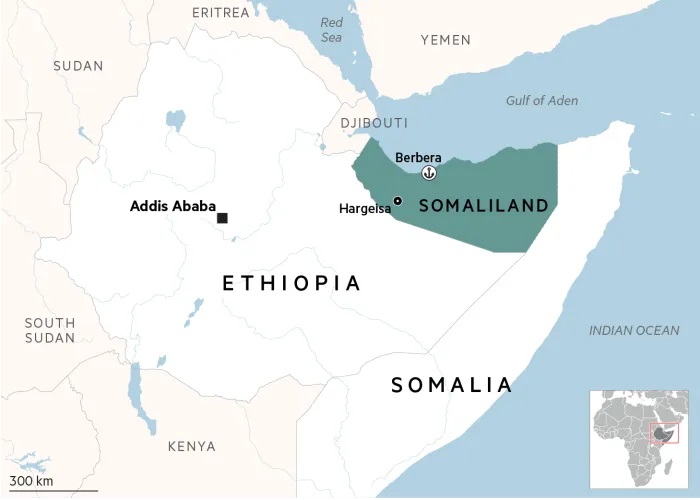
ADDIS ABABA (SD) – Ethiopian Prime Minister Abiy Ahmed is facing significant criticism and widespread anger from across the Horn of Africa after a map displayed on social media—purportedly from his official office—appeared to incorporate territories belonging to Somalia, Eritrea, and Djibouti, particularly coastal areas along the Red Sea.
The controversial map was seen in a video broadcast from the official Facebook page of the Ethiopian Prime Minister’s Office during his meeting with the Indian Prime Minister in Addis Ababa last Wednesday.
The video has triggered strong reactions, with numerous analysts, academics, and active social media users from across the Horn of Africa describing the move as indicative of expansive territorial ambitions and an attempt to revive Ethiopia’s historical drive for sea access.
Some analysts have stated that displaying such a map constitutes a dangerous political message, directly harming the sovereignty and internationally recognized borders of Ethiopia’s neighbouring countries.
They have also warned that this issue could reignite political and security tensions in a region already grappling with existing conflicts and fragile security situations.
Furthermore, many have labelled this action as “clear provocation,” calling on the international community and regional organizations to closely monitor such developments to prevent a potential major conflict in the Horn of Africa.
Regional affairs experts have emphasized that reopening border and maritime access issues in this manner brings no benefit to regional stability. Instead, it could hinder the cooperative and economic integration efforts that the countries in the region desperately need during this critical time.
The incident walks the line between a deliberate strategic signal and a catastrophic public relations blunder. If intentional, it represents Abiy Ahmed’s most audacious move yet to publicly stake Ethiopia’s claim to Red Sea access, directly challenging the sovereignty of three neighbours simultaneously. If a mistake by a subordinate reveals a shocking lack of oversight and sensitivity within the Prime Minister’s Office, it damages Ethiopia’s diplomatic credibility at a critical juncture.
Abiy Ahmed’s public emphasis on Ethiopia’s “historical right” to sea access is primarily a domestic political tool. By presenting himself as the champion of a national cause, he diverts attention from immense internal challenges: post-war reconstruction in Tigray, economic crisis, and ethnic tensions. This map incident escalates that rhetoric into a visual, tangible claim, potentially rallying nationalist sentiment, but at the tremendous cost of foreign relations.
The map has the paradoxical effect of uniting Somalia, Eritrea, and Djibouti—countries with complex relations—in shared outrage. This collective front significantly raises the diplomatic and potential security cost for Ethiopia. It pushes these nations closer together and towards other external partners (like Turkey, the UAE, or Egypt) who may be willing to support them as a check on Ethiopian ambitions.
This move strikes at the heart of IGAD-led diplomacy and the fragile economic interdependence in the Horn. It shatters any trust necessary for resolving existing disputes (like the Ethiopia-Somaliland MoU) and jeopardizes critical infrastructure projects and trade. Experts are right to warn that it reverses progress on the very cooperation needed for regional prosperity.
The call for international monitoring is urgent. The UN, AU, and key powers (US, EU, China) must clarify that border changes by force or coercive diplomacy are unacceptable. Failure to respond firmly could embolden Ethiopia and compel its neighbours to seek security guarantees, potentially militarizing the issue. Somalia, in particular, may frame this as an existential threat, justifying greater military preparedness and appeals for international support under the principle of territorial integrity.
The map incident is a dangerous inflection point. It transforms Abiy Ahmed’s sea-access discourse from verbal posturing into a perceived cartographic aggression. Whether a tactic or an error, it has injected a high degree of mistrust and volatility into an already unstable region. The immediate priority for all actors must be de-escalation and clear reaffirmation of respect for existing borders. Otherwise, the Horn of Africa risks sliding from a period of fraught diplomacy into a new chapter of overt confrontation, where nationalistic maps could precede more tangible conflicts.
Categories: Latest News