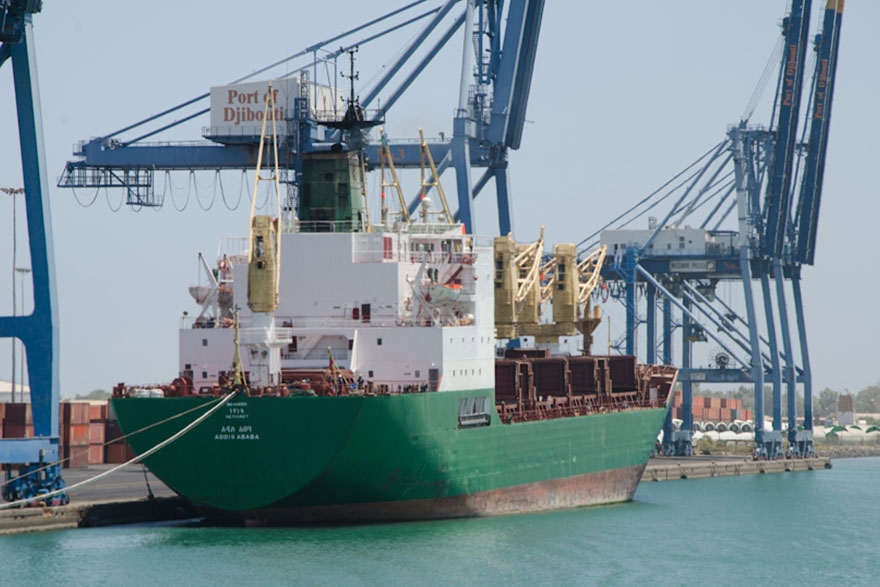
DUBAI (SD) – The global port operator DP World, based in the United Arab Emirates, has rejected the Federal Government of Somalia’s (FGS) decision to annul all agreements signed with the UAE.
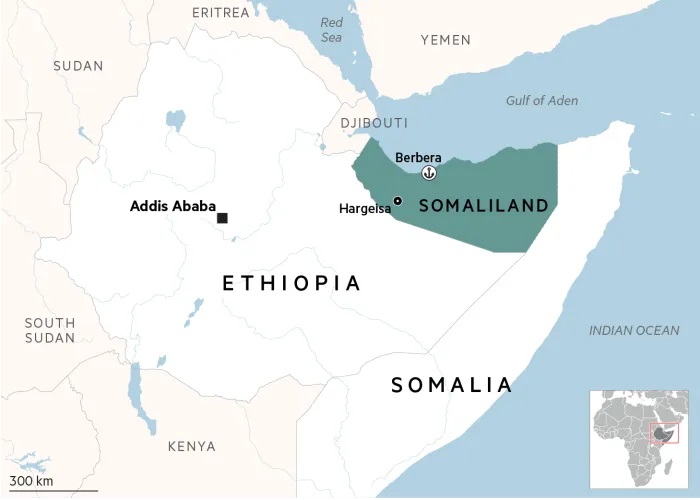
The company affirmed that operations at Berbera Port will proceed normally and that Somalia’s internal political conflict will not impact its activities.
In a statement shared with Reuters, DP World confirmed that the port’s operations, commercial services, and vessel traffic are functioning as usual, without interruption, and adhering to the previously established agreements.
DP World’s position follows the FGS’s announcement that it has nullified all agreements with the UAE, including those related to ports, security, and defence cooperation, accusing the UAE of violating Somalia’s sovereignty and unity.
DP World emphasized that political decisions, intergovernmental discussions, and diplomatic stances should be left to the appropriate authorities, while the company remains focused on its commercial operations and port management.
The Somali government, which does not recognize Somaliland—recently granted full recognition by Israel—has also opposed DP World’s agreements for the ports of Bossaso and Kismayo, neither of which is under its direct control.
The Federal Member States of Puntland and Jubaland have separately opposed Mogadishu’s decision to terminate their agreements with DP World.
DP World’s declaration affirming the continuation of Berbera Port operations demonstrates the UAE’s confidence in Somaliland’s autonomy and effectively dismisses Somalia’s claim over Berbera.
The Reuters report highlighted that this tension coincides with rising conflict in Yemen, involving Saudi Arabia and the UAE, while the Somali government has launched an investigation into allegations that the UAE illegally transported a separatist leader from Yemen via Somalia.
DP World’s outright rejection of the FGS’s annulment indicates that, supported by the UAE, it considers its contracts with Somaliland and the Federal Member States as legally binding commercial agreements that surpass the political claims of the Somali central government. This sets a precedent in which international investors can decide which government authority to recognize in sovereignty disputes.
By publicly defying Mogadishu, the UAE is making a strategic move. It avoids direct state-to-state confrontation (for now) but sends a clear message: our economic and strategic interests in Somaliland and the Horn are non-negotiable, and we possess the means to protect them. This consolidates Somaliland’s position and undermines Somalia, illustrating that Mogadishu’s decrees are ineffective where it matters most—on economic infrastructure.
DP World’s statement, combined with opposition from Puntland and Jubaland, vividly exposes the limits of the FGS’s authority. It reveals a Somalia where the central government cannot enforce its foreign policy or legal decisions within its own territory. This weakness weakens Somalia’s broader sovereignty claims, as it cannot exert control over key assets and regions.
This standoff will attract scrutiny from global investors and arbitration courts. DP World’s stance effectively disregards the FGS, signalling that in contested regions, agreements with de facto authorities may hold more weight than the decrees of internationally recognized but ineffective central governments. This may influence investment risk assessments in similar regions worldwide.
Categories: Latest News