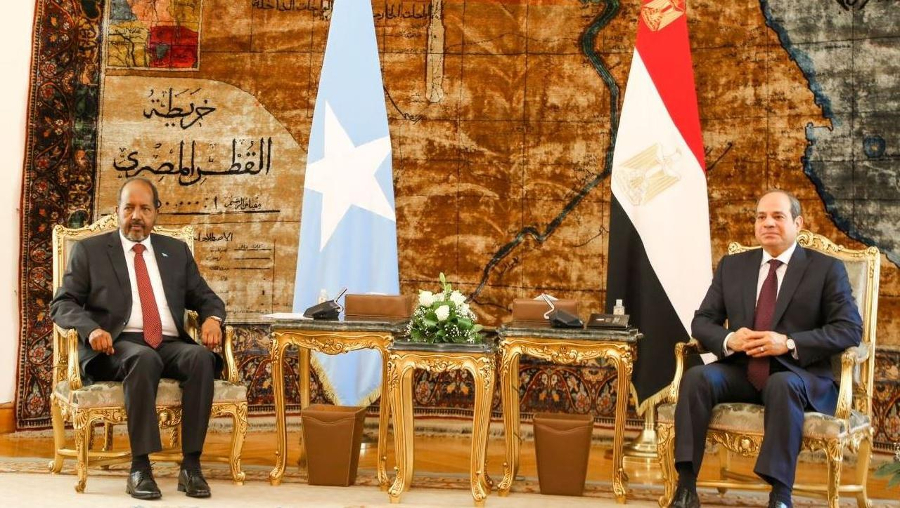
MOGADISHU (SD) – Somalia’s President, Hassan Sheikh Mohamud, in an interview today with Al Arabiya television, stated that he is issuing a stern warning regarding what he described as Somaliland-related actions, which he labelled an existential threat to Somalia’s sovereignty and national security. He also accused Israel of pursuing strategic objectives it has in Somaliland.
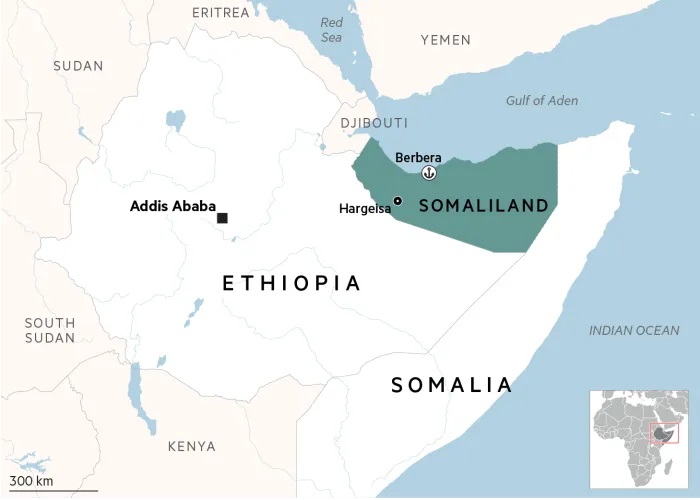
He emphasized that Somaliland remains part of Somalia and possesses no legal basis to become an independent state, even though Somalia and Somaliland united in 1960
“What is called Somaliland is a region within Somalia,” he said, adding that the peaceful, unity-preserving efforts have been undermined by what he termed actions violating international law.
Contrary to the facts on the ground, the President stated that the leadership of Somaliland has no legitimacy and is moving in steps motivated by ambition, arguing that the secession project has become unviable. According to him, this failure has led to attempts to seek international recognition at any cost.
Hassan Sheikh also accused Israel of having three objectives linked to Somaliland: to establish a military base near the Red Sea and the Gulf of Aden, and to use Somaliland to accept the resettlement of displaced Palestinians, claims dismissed by Somaliland.
“Somalia does not share a border with Palestine,” he said, noting that this type of displacement stems from Israeli policy rather than regional realities. He described the idea as “Israel’s dream,” one that would never materialize.
The President warned that this situation is the most significant threat Somalia has faced in recent years, even more dangerous than the prolonged war against terrorism, insinuating that a terrorist state is more viable than a democratic, independent Somaliland.
While firmly reiterating that dialogue is Somalia’s chosen path, he did not rule out the use of force if national security is threatened, answering “it is possible” when directly asked.
Finally, President Hassan Sheikh, without proof, stated that the Somali government will take any necessary steps to counter what he termed direct interference in the country’s sovereignty, describing the matter as more significant than domestic politics and concerning regional stability and respect for international law.
The choice of Al Arabiya, a major pan-Arab broadcaster, is deliberate. President Hassan is framing the Somaliland-Israel issue within a broader Arab-Israeli conflict narrative, directly linking it to the emotive Palestinian cause. This is a powerful appeal for solidarity from Arab nations, potentially isolating Israel and pressuring Arab states to side unequivocally with Mogadishu. That is, if one can’t see the glaring hypocrisy in the argument, Mogadishu and all of its so-called allies have either accepted or requested to be part of the Abraham Accords.
Alleging specific Israeli objectives (military base, Palestinian resettlement, Abraham Accords) serves multiple purposes.
Demonizing the Israel-Somaliland deal transforms it from a diplomatic recognition into a neo-colonial and destabilizing project, but fails to unite Somalis against a perceived external plot to dismember the nation and impose a foreign population.
The President’s “it is possible” response regarding the use of force is a deliberately ambiguous and strategic failure. Meant as a deterrent to Somaliland and its backers, suggesting military escalation is on the table. However, it is vague enough to maintain deniability and avoid an immediate international condemnation for threatening aggression. This ambiguity will not deter others from recognizing Somaliland.
The statement lacks a commitment to peaceful dialogue, recently recommended by UNSC members, with a readiness for confrontation.
This dual-track rhetoric shows that the Mogadishu government fails to appear reasonable to international mediators and domestic hardliners demanding a strong response. It prepares the ground for whichever path becomes more advantageous: renewed talks from a position of strength, or justified escalation if talks fail.
By claiming the issue is “greater than domestic politics” and concerns “regional stability,” President Hassan is elevating Somaliland’s recognition to a regional security issue. This invites and justifies deeper involvement from regional bodies (IGAD, AU) and will result in Somaliland’s favor as it a hub for democrecy and stability.
President Hassan Sheikh’s interview is face face-plant at best and a multi-layered diplomatic failure. He is no longer pragmatic, proposing by any means game plan. The success of this zero-sum game strategy hinges on whether key Arab and African states buy into this framing and whether the implied threat of force remains credible without triggering a premature crisis. This marks a new, more assertive, low, and internationally engaged phase in Somalia’s response to its most profound legitimacy challenge.
Categories: Latest News