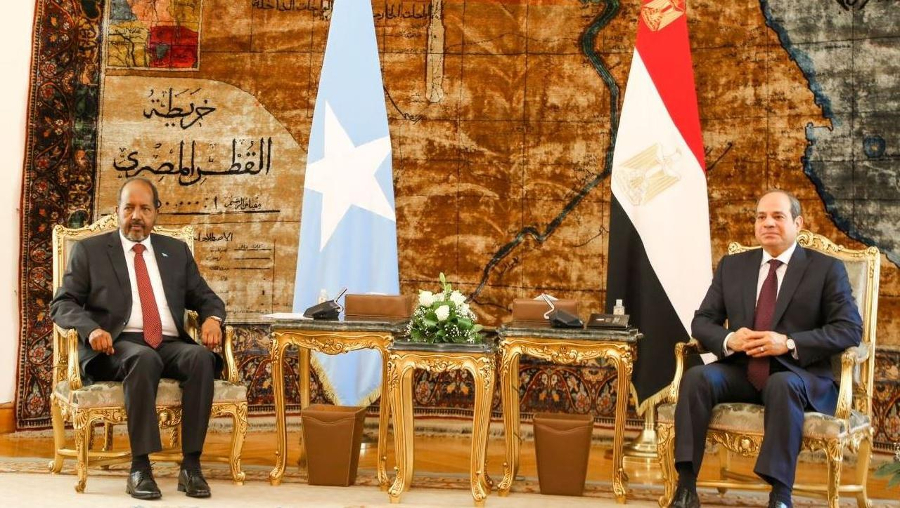
DOHA (SD) – In an interview with Al Jazeera, Somalia’s President, Hassan Sheikh Mohamud, confirmed that the missing element between Somalia and Israel is formal diplomatic relations. He stated that Israel is a member state of the United Nations and that Somalia accepts its existence as a state.
The possibility raised by the President—that Somalia could establish relations with Israel—also serves as evidence that Somalia, at this time, does not entirely oppose the framework initiated by Trump known as the Abraham Accords.
These two perspectives remove the basis of the argument used by Somalia, who oppose the recognition Somaliland received from Israel.
President Hassan appears to be conveying the view that Israel needs to go through Mogadishu, which holds the legal authority. Although it is reported that the President met with political figures this week and was presented with an earlier-stage proposal for Somalia to join the Abraham Accords—which aims to establish relations between Arab states, other Muslim countries, and Israel—he reportedly rejected that proposal at the time. However, the interview he gave suggests he may have retreated from his previous rejection.
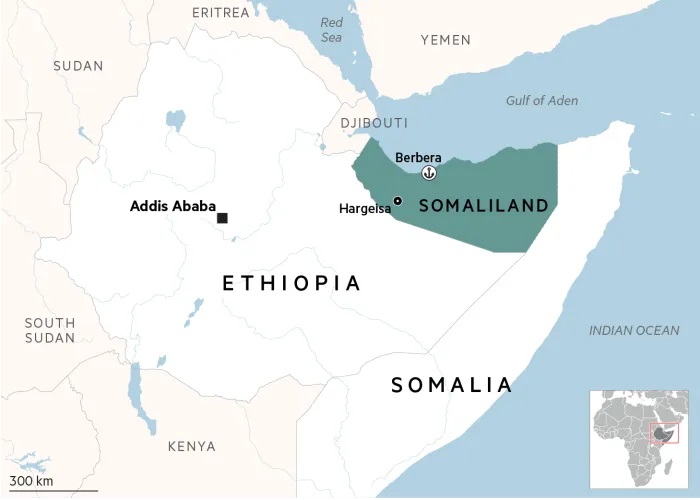
The President has previously engaged with similar ambiguity regarding the Ethiopia-Somaliland memorandum of understanding, launching a broad diplomatic offensive that ultimately resulted in the Ethiopian Prime Minister being welcomed in Mogadishu, with Türkiye playing a role in de-escalating the tensions that existed then.
Nevertheless, in the current phase, Ethiopia has renewed a position that appears contrary to Somalia’s interests, although it has not clearly stated its stance. However, sources close to Addis Ababa indicate that Ethiopia would not oppose Israel, a point linked to Israel’s previous campaign to attract Horn of Africa countries before announcing its recognition of Somaliland.
Similarly, Israel presented Addis Ababa with plans for security participation related to Gaza, which could involve deploying Ethiopian troops—an opportunity that could give Ethiopia, particularly Abiy Ahmed, diplomatic leverage and a path to get closer to the Washington administration.
Any attempt by Mogadishu to find a way to contain or engage with Israel’s initiative is not easy.
Can Somalia obtain something better than what Somaliland offered Israel?
Mogadishu’s strongest card is that any agreement must obtain legal authority. Countries like Morocco resolved their challenges by joining the Abraham Accords; Morocco’s joining led to the recognition of Western Sahara as an autonomous region under Moroccan administration, removing the independence sought by Polisario. Sudan, which had alliances with Saudi Arabia and countries now supporting Somalia’s diplomatic efforts, agreed to allow relations with Israel, and thus Khartoum agreed to join the Abraham Accords—though ongoing wars have delayed the agreement’s implementation. Khartoum saw the solution to its problems as lying in establishing relations with Israel. But if Mogadishu takes a similar position, it also faces the question: Would the solution simply be accepting Israel, and what is the argument to convince the people of Somaliland?
For nearly a week since Israel’s decision emerged, there has been no specific policy or vision presented by President Hassan. The efforts undertaken so far have received international condemnation in support of Somali unity. In contrast, the opposition and some sections of society are critical of Villa Somalia’s approach to this phase; even some opposition members who met with President Hassan said he showed no concern and would not change his position on issues causing internal conflict, prioritizing a lack of urgency for elections over reaching an agreement. Meanwhile, the President of Somaliland, Abdirahman Cirro, today informed the public that there are other countries joining Israel in recognizing Somaliland.
Finally, President Hassan told Al Jazeera he had received intelligence confirming that Somaliland obtained recognition by agreeing to three conditions: first, the resettlement of Palestinians in Somaliland; second, granting Israel a military base on the Red Sea coast; and third, Somaliland joining the Abraham Accords. These are the three demands of Israel, which he stated Somaliland accepted.
When asked what would happen if these three conditions were implemented, he replied: “Pandora’s Box will be opened for the world,” meaning endless trouble would ensue—one that benefits no side.
President Hassan’s statement is a seismic shift in Somali foreign policy. It is a deliberate and high-risk diplomatic signal, not an offhand remark. By publicly stating that formal relations with Israel are the only missing element, he is performing several maneuvers simultaneously: acknowledging reality, opening a potential backchannel, and most importantly, attempting to reclaim the initiative from Somaliland. He is signalling to Israel: If you want a Red Sea partner, negotiate with the legitimate government, not a breakaway region.
The core of the President’s move is to reframe the narrative. By claiming Somaliland’s recognition came at the cost of agreeing to resettle Palestinians and host an Israeli base, he transforms Somaliland’s diplomatic victory into a story of national betrayal and dangerous concession. This is potent domestic propaganda aimed at uniting Somalis against Somaliland’s leadership and deterring other nations from following Israel’s lead by painting the deal as toxic and extreme.
The “Pandora’s Box” metaphor is a direct threat and a prediction. It warns Israel and the international community that implementing such a deal (Palestinian resettlement, Israeli base) would unleash uncontrollable regional chaos, including mass radicalization, proxy wars, and the complete destabilization of the Horn of Africa. This positions Somalia not as a passive victim, but as a key stakeholder whose warnings must be heeded to avoid disaster.
This pivot is fraught with domestic peril. It risks alienating powerful domestic constituencies, including Islamist groups, pan-Somali nationalists, and factions within his own government, for even hinting at relations with Israel. His careful phrasing—”accepts its existence as a state” rather than full normalization—is a linguistic buffer. However, the opposition will seize on this to accuse him of weakness and being prepared to sell out core principles.
This statement is a direct test for the United States and other Western backers. It forces them to choose: Will they support Somalia’s sovereignty by pressuring Israel to engage Mogadishu, or will they tacitly accept Israel’s bilateral deal with Somaliland? President Hassan is essentially asking the U.S.: Do you prioritize our counterterrorism partnership and state-building project, or your unconditional support for Israel’s unilateral actions?
Beneath the outrage, the statement cracks open a door for realpolitik. By separating the issue of Israel’s existence (which he accepts) from the issue of Somaliland’s recognition (which he rejects), he creates a hypothetical space for future negotiation. The unspoken message to Israel could be: Reverse the recognition, and a broader regional engagement—potentially including Somalia—might be possible.
President Hassan Sheikh has moved from defence to a form of hypocritical diplomacy. He is attempting to weaponize transparency by alleging shocking terms in the Israel-Somaliland deal, while simultaneously presenting Somalia as the rational, lawful alternative partner. This is a high-stakes gamble to isolate Somaliland internationally, rally domestic unity through a narrative of sacrifice, and force the great powers to intervene on Mogadishu’s terms. The success of this strategy hinges on the credibility of his intelligence claims and the willingness of the U.S. and Arab states to pressure Israel. If it fails, he risks being seen as both powerless against Somaliland and blasphemous for engaging with Israel. If it succeeds, he could dramatically reverse Somaliland’s momentum and reassert Mogadishu as the indispensable power broker in the Horn of Africa. The next moves from Washington, Riyadh, Cairo, and Tel Aviv will be decisive.
Categories: Latest News