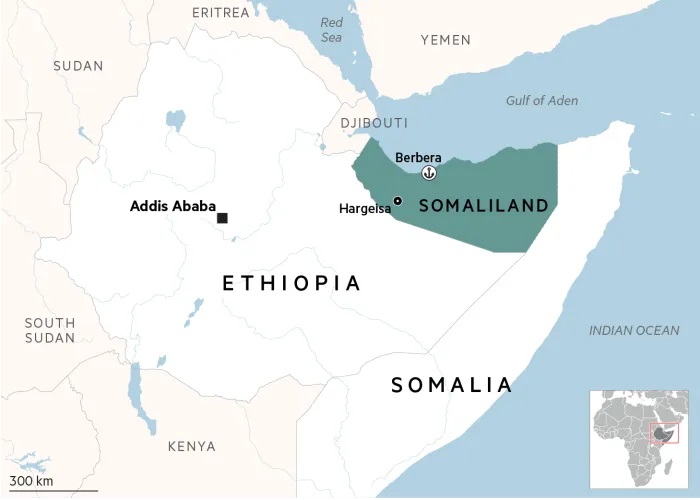
DUBAI (SD) – The President of Somaliland, Abdirahman Mohamed Abdullahi Irro, has argued that if Somalia wants to unify Somalis, it should unite with Djibouti, the Somali Regional State of Ethiopia, and the North Eastern Province of Kenya to join Somalia.
“If Somali unity is desired, Djibouti should join Somalia; it was historically part of it. The Somali region of Ethiopia should join Somalia. The NFD (North Eastern Province) should join. If they’ll wantsSomali unity, they should all unite. What makes the unity between Somalia and Somaliland special?” Irro told Sky News Arabia.
He stated that many countries in the world do not properly understand Somali history, noting that Somali lands in the Horn of Africa were divided into five parts after the Berlin Conference of 1884, and that Somaliland became the first part to gain independence from colonial rule in 1960, and was recognized by 35 countries, including Israel.
Therefore, he said the responsibility placed upon him is to deliver Somaliland’s message to the world, noting that the people of Somaliland rejected the union shortly after it was formed due to violations committed against them, which led to them regaining their Independence. He stated that a renewed union is never possible.
The conflict between Somaliland and the Federal Government of Somalia flared up again at the end of last year after the Israeli government recognized Somaliland, which angered Somali leaders.
For its part, Somaliland is waging a diplomatic campaign seeking international recognition, defending its cause for recognition on global platforms.
President Irro is a strategic and factual framing of the entire Somali unity debate, turning the tables on Mogadishu’s sovereignty claims with a historical and pan-Somali nationalist argument.
Irro does not defend Somaliland’s Independence on purely practical or governance grounds (stability, democracy). Instead, he pointsout the very foundation of Somalia’s argument by invoking the ideology of “Greater Somalia” – the unification of all Somali-inhabited territories. If Somalia’s basis for unity is ethnic and historical unity, then you must apply that same logic consistently to all other Somali territories currently outside the Somali Republic.
The President Irro’s point is to expose a perceived hypocrisy in Mogadishu’s position. He frames it as: Somalia demands unity with Somaliland based on shared ethnicity/history, but does not actively seek (or dare not seek) unity with the Somali regions of Ethiopia, Kenya, and Djibouti. Therefore, he implies, the demand on Somaliland is politically selective and unjust.
He grounds Somaliland’s case in a specific historical narrative. Somaliland’s prior existence as a sovereign state (independence in 1960, recognition by 35 states). The union with Somalia in 1960 was a voluntary act that was later violated, justifying dissolution. This frames Somaliland not as a secessionist region, but as a former state reclaiming its sovereignty after a failed merger.
The mention of Djibouti, Ethiopian Somalis (Somali Regional State) and Kenyan Somalis (NFD) is particularly sharp. These regions have their own complex relationships with their central governments, despite a lack of support from Mogadishu. By raising the potential unification with Somalia, Irro subtly highlights the fragility of borders in the Horn and the potential for Somalia’s unity rhetoric to destabilize its neighbours.
In essence, President Irro is not just defending Somaliland’s Independence; he is launching a philosophical attack on the legitimacy of the modern Somali state’s borders and its claim over his territory. He internationalizes the dispute by tying it to the larger, unresolved question of colonial borders and ethnic nationalism in the Horn of Africa. This makes the Somaliland issue not just a bilateral Somali problem, but a regional one with implications for Ethiopia and Kenya as well. It is a high-reward rhetoric that seeks to permanently alter the terms of the debate.
Categories: Latest News