UNITED NATIONS (SD)– A heated exchange erupted during the UN Security Council debate between Somalia’s Permanent Representative to the UN, Abukar Dahir Osman (Balle), and Jonathan Miller, Israel’s Deputy Permanent Representative to the United Nations.
The Israeli representative defended his country’s decision to recognize Somaliland, arguing that the people of Somaliland had endured severe suffering and massacres. He stated they were previously an independent people united with Somalia and that now is the time for their recognition, asserting they would not return to Somalia.
Israel’s deputy UN representative, Jonathan Miller, said the move was “not a hostile step towards Somalia, and it does not preclude future dialogue between the parties,” calling it “an opportunity to strengthen stability.”
Somalia’s UN Ambassador, Abukar Balle, vehemently refuted the claims of massacres in Somaliland perpetrated by the Siad Barre regime. A massacre that was apologized for by the previous Somali President, Farmajo. Balle responded with anger and seemed flustered and unprepared for the Israeli envoy’s remarks in the Security Council, where he had pointed out and touted Somaliland’s democratic history despite Somalia’s treatment and opposition.
“It is a disgrace for the Security Council to listen to a representative from Israel—a state with blood on its hands—lecture us about massacres in Somaliland, massacres of children, women, doctors, and patients in hospitals,” stated Abukar Baalle.
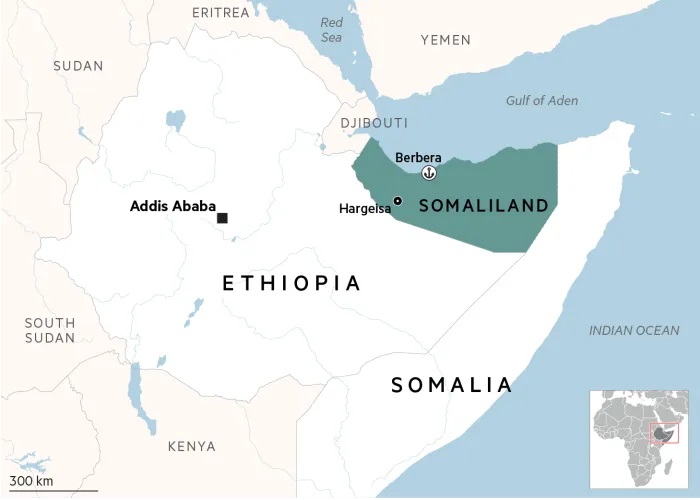
He emphasized that Somalia cannot be divided, sharing one country, one religion, and one people. He added, “The Somaliland that Britain ruled consisted of two regions: the Northeastern region and the Northwestern region. Today, the Northeastern region is part of the Federal Government of Somalia (FGS), constituting 45% of the land and population, and Awdal is the border with Djibouti.”
Ambassador Abukar Balle’s lack of knowledge of the Israeli representative’s historical arguments—which included the claim that Somaliland declared independence on June 26, 1960, was recognized by 35 states, and then merged with Somalia—was widely circulated on social media.
The Security Council session concluded without a unified resolution on Israel’s recognition of Somaliland. Four of the five permanent members—China, Russia, the UK, and France—generally supported Somalia’s position. The United States remained cautious, not altering its policy of supporting Somalia’s unity but affirming Israel’s right to establish diplomatic relations with whomever it chooses.
The other ten non-permanent member states were also divided in their reactions to Israel’s recognition of Somaliland. The next step will be a formal session of the UN Security Council presidency, which will be handed over to Somalia next week.
The verbal clash is not merely a diplomatic spat but a critical battle for international legitimacy on the world’s most powerful security stage. Both sides are using the Council to frame the narrative: Israel/Somaliland as a just cause for self-determination versus Somalia as a victim of aggression violating territorial integrity. The failure to produce a resolution shows the issue is deeply divisive at the highest level, with major powers taking clear but conflicting sides.
The debate presented a stark contrast in historical narratives. Israel’s envoy invoked Somaliland’s past suffering (the 1980s civil war) to justify recognition as a corrective act. Somalia’s envoy reframing the debate on Israel’s own human rights record, calling its moral authority into question, and pandering to states critical of Israeli policies.
Ambassador Balle’s emphasis on “one country, one religion, one people” is the foundational irredentist narrative of the Somali state. His deconstruction of “Somaliland” into its British-administered components (NE and NW) is seen as a non-argument in legal circles.
Somalia assuming the Security Council presidency next week, is a game-changing opportunity. It could allow Mogadishu to control the agenda, potentially bringing the issue for a formal vote or structuring debates to maximize pressure on Israel and isolate Somaliland. This procedural advantage could force clearer positions from wavering states and test the limits of U.S. support for Israel versus its commitment to Somalia.
The lack of a condemning resolution, while not a win for Israel, is also not a loss. In diplomatic terms, preventing a negative outcome is a form of success. Israel and Somaliland can continue to operate in the space created by the international division. For Somalia, the vocal support from four P5 members is significant, but the U.S. hedge and the lack of consensus reveal the limits of its diplomatic capital and the potency of the precedent Israel has set.
The UNSC session transformed the bilateral recognition into a multilateral legitimacy crisis. It revealed deep international fractures, with powerful states choosing sides based on principle, strategy, and historical baggage. Somalia won the moral and rhetorical battle in the chamber, but Israel/Somaliland succeeded in creating a fait accompli that the Council could not collectively reject. The upcoming Somali presidency promises an even more intense diplomatic showdown, where procedural power will meet raw political will. The world is now watching to see if the UN’s territorial integrity can withstand this direct challenge of self-determination, or if a new, contested reality in the Horn of Africa will be tacitly accepted by a divided international community.
Categories: Latest News