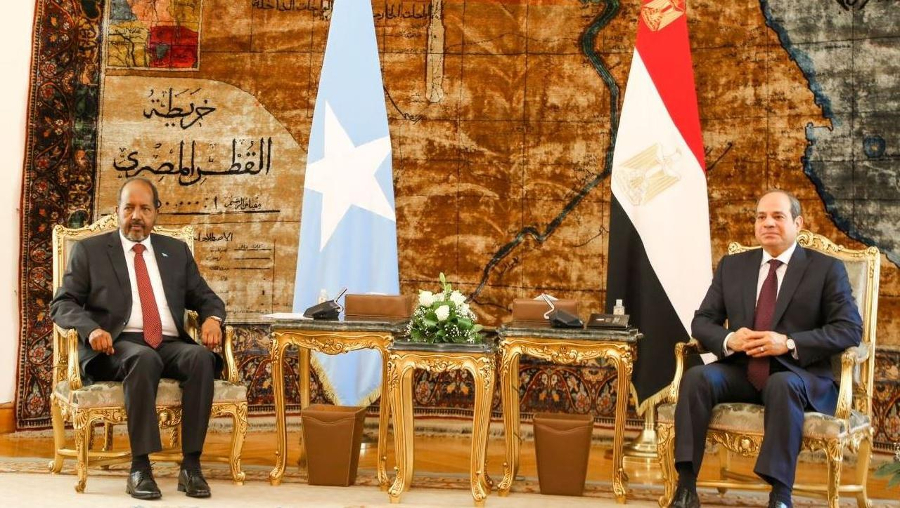
ADDIS ABABA (SD) – The Ministry of Foreign Affairs of the United Arab Emirates (MoFA) and the African Union (AU) have issued a joint statement addressing matters, including the sovereignty of Somalia.
A press release issued by the African Union, discussing a meeting held in Addis Ababa between the Chairperson of the African Union Commission and the UAE’s Minister of State for Foreign Affairs, Sheikh Shakhboot bin Nahyan Al Nahyan, also addressed violations related to the UAE’s sovereignty over the Greater Tunb, Lesser Tunb, and Abu Musa islands, which are occupied by Iran.
The UAE claims these islands are part of its territory. This implies that the UAE’s support for Somali unity is contingent upon the African Union supporting Abu Dhabi’s quest to regain the islands occupied by Iran.
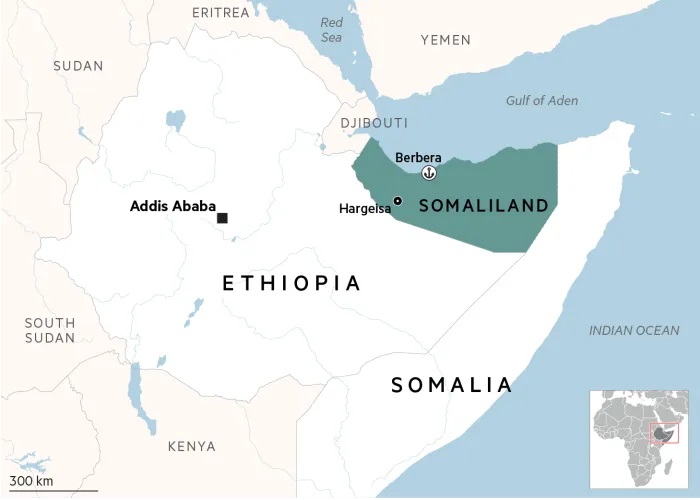
This statement notably did not address Israel’s recent recognition of Somaliland, a move considered to have no significant impact.
Similarly, the joint statement by the UAE and the AU did not condemn the visit of Israeli Foreign Minister Gideon Sa’ar to Hargeisa.
The Federal Government of Somalia had previously opposed this visit, describing it as a violation of its territory.
The statements from the UAE and the African Union appear aimed at containing the diplomatic tensions arising from the recognition of Somaliland—which is linked to the UAE—and at strengthening relations with the central government in Mogadishu.
Diplomatic engagements involving Riyadh, Ankara, and Cairo failed to force the UAE to scale back its courageous diplomatic engagement towards Somaliland.
The UAE’s Minister of State for Foreign Affairs, Shakhboot Bin Nahyan, who arrived in the region today, did not directly address Israel’s recognition of Somaliland or the UAE’s position on the Somaliland issue.
The core of this statement reveals a stark quid pro quo. The UAE’s support for Somalia’s territorial integrity is overshadowed by the AU’s support for the UAE’s claim over islands occupied by Iran. This transforms a matter of principle (respect for sovereignty) into a diplomatic transaction. It undermines the moral high ground of both entities, exposing their support as conditional and driven by parallel national interests rather than a commitment to international law.
The deliberate omission of any mention of Israel’s recognition or the Israeli FM’s visit is the most telling aspect. This strategic silence serves multiple purposes:
The UAE avoided confrontation with Israel, with whom it has normalized relations under the Abraham Accords, thereby protecting a valuable strategic partnership.
The AU avoided taking a firm, divisive stance that could split its members, some of whom may have pragmatic ties with Somaliland or Israel.
For both, It signals to Mogadishu that their support has limits and will not extend to confronting Israel directly, a red line for the UAE and a complex issue for the AU.
While on the surface a statement supporting its unity, this development is a net negative for Somalia. It reveals that, Its allies’ support is conditional and negotiable.
Even its closest regional partners (AU, some Arab states) are unwilling to directly challenge Israel over this issue.
The diplomatic battle is being fought over other countries’ territorial disputes (UAE vs. Iran), not the core merit of Somalia’s case
By engaging in this transactional diplomacy, the AU undermines its role as an impartial arbiter dedicated to African solutions. It appears willing to barter its normative stance on sovereignty to gain support for a member state’s (UAE) extra-continental dispute. This could damage its credibility in mediating not only the Somalia-Somaliland issue but other secessionist conflicts across the continent.
This episode suggests that the international response will be fragmented and driven by broader geopolitical alliances, not a unified defense of Somalia’s territorial integrity. Somalia cannot rely on automatic, principled support. It must now navigate a complex landscape where its cause is used as a bargaining chip in unrelated disputes, and where even supporters will avoid actions that jeopardize their relations with Israel or other powerful actors.
The UAE-AU statement is a classic example of realpolitik masquerading as principle. It provides Somalia with verbal support but reveals the hollow and transactional nature of that support. The strategic silences are louder than the words spoken. For Somaliland and Israel, this ambiguity is a victory, as it shows that major regional institutions and powers are not willing to mount a concerted campaign against their actions. The path forward for Somalia is increasingly narrow, requiring it to build a more compelling case that aligns its interests with the concrete strategic calculations of powerful states, rather than relying on appeals to international law that few are willing to enforce when it becomes inconvenient.
Categories: Latest News