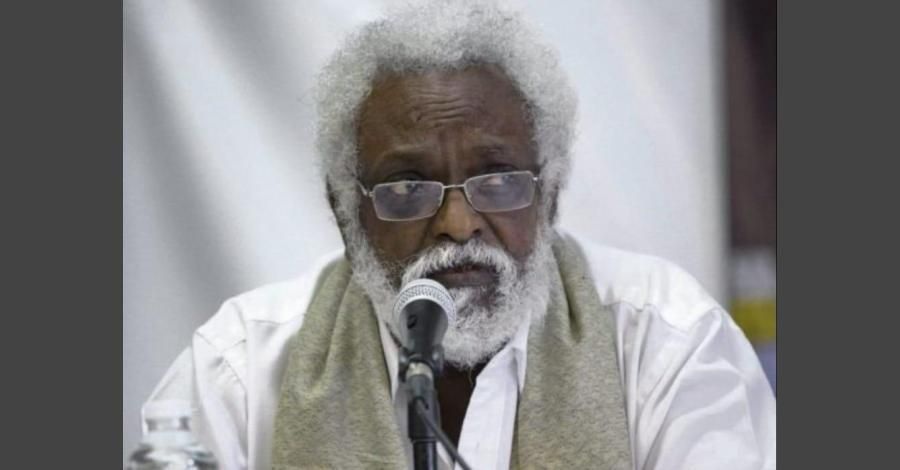
MOGADISHU (SD) — Hirshabelle Vice President Yusuf Hagar Dabaged has warned that elections cannot be held in Somalia’s Hiiraan region without a prior political agreement and broad consensus among the region’s political and community stakeholders.
Speaking at a gathering of Hawadle elders and politicians in Mogadishu, Dabageed said the electoral process in Hirshabelle cannot be determined unilaterally by one political side. He called for consultations involving political leaders, traditional elders, civil society representatives and other influential stakeholders.
Dabageed issued a particularly strong warning regarding Hiiraan, saying that elections could not be conducted “even in a single village” without an agreement acceptable to the relevant parties. He said anyone attempting to organize elections without first reaching a political settlement would be responsible for the consequences.
“The current electoral process in Hirshabelle cannot continue in its present form,” Dabageed said, according to reports of his remarks. He argued that stakeholders must first agree on how the election should be conducted and how the administration’s political transition should be managed.
His warning comes as tensions increase over the upcoming Hirshabelle elections and the question of who should lead the regional administration. The National Independent Electoral and Boundaries Commission has set September 30, 2026, as the new polling date for simultaneous local council and House of Representatives elections in Hirshabelle. Voter-card distribution is scheduled to begin on September 16, followed by candidate-list verification on September 17 and publication of the final voter register on September 19.
Dabageed has also accused Somali President Hassan Sheikh Mohamud of reversing an alleged political understanding with the Hawadle community over the leadership of Hirshabelle. According to Dabageed, Hawadle elders and politicians had previously been assured that the community would be considered for the presidency of Hirshabelle during the coming political transition.
Dabageed said a delegation led by Hawadle traditional leader Ugas Yusuf Ugas Hassan had discussed the issue with President Hassan Sheikh several months ago. He claimed the community had agreed to support the federal government and avoid opposition in return for consideration of a Hawadle candidate for the Hirshabelle presidency.
According to Dabageed, President Hassan Sheikh initially indicated that the Hirshabelle presidency would go to the Hawadle community but later told him that the commitment had been abandoned and that the position would instead be given to current Hirshabelle President Ali Abdullahi Hussein Gudlawe, who belongs to the Abgaal community. These claims have not been independently confirmed, and the president has not publicly responded to Dabaged’s allegations in the reports reviewed.
Dabaged has urged the Hawadle community to hold broader consultations over its political future, saying decisions should not be left only to people living in Hirshabelle. He called for the participation of Hawadle elders, politicians and members of the community living elsewhere in Somalia and abroad.
The dispute adds another layer of uncertainty to Hirshabelle’s electoral preparations. With the September 30 vote approaching, the disagreement over political representation and the leadership transition could make it more difficult to implement the electoral timetable without an understanding among the principal stakeholders.
Dabaged’s warning raises the possibility of a serious political confrontation if the electoral authorities proceed with voting in Hiiraan without securing agreement from influential local actors. His reference to elections being impossible even in a single village signals the depth of opposition to the current process.
The dispute also illustrates the broader challenge facing Somalia’s electoral transition: formal electoral timetables may not be sufficient where political and clan-based agreements remain unresolved. If the federal government and Hirshabelle stakeholders fail to reach a compromise, the disagreement could become a significant test of the credibility and stability of the regional electoral process.
Categories: Latest News